
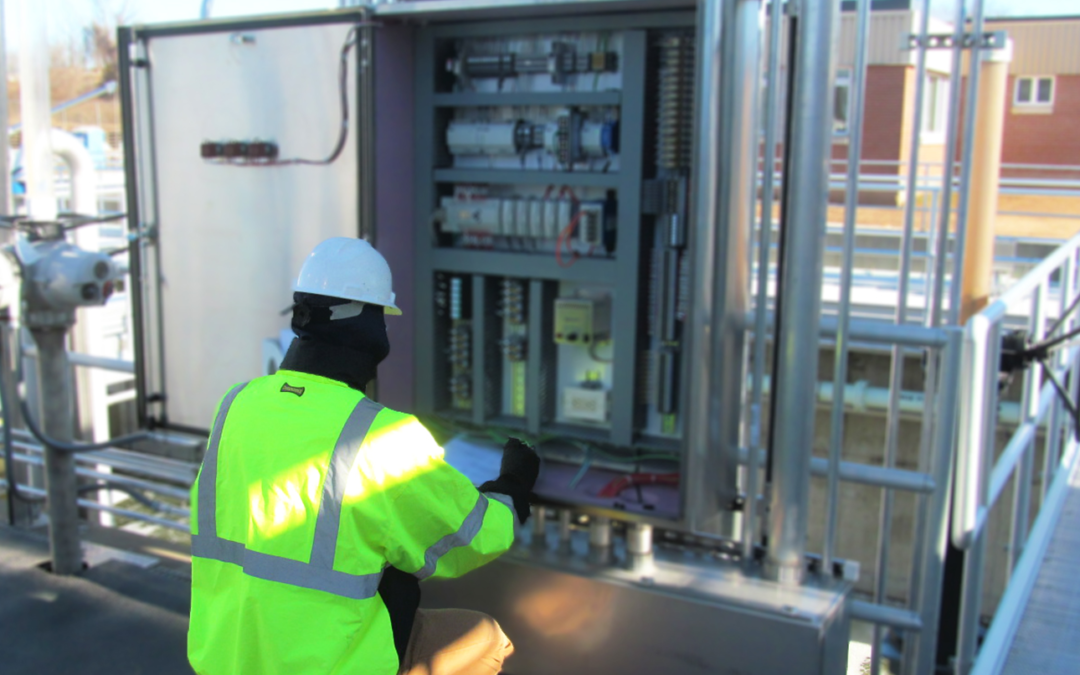
Wright-Pierce’s Phill Arnold, Senior Control System Technician, explores the choice between translating and converting a programmable logic controller (PLC) program when modernizing a water or wastewater facility’s control system and how each approach preserves the process behavior the facility relies on.
The Challenge of PLC Modernization
Water and wastewater facilities depend on PLCs to promote the reliable operation of essential infrastructure. From wastewater pump stations and treatment processes to water filtration and distribution, PLC-based control systems are at the core of protecting public health and the environment.
Many facilities operate control systems that have been in service for decades. Over time, PLC platforms reach the end of their supported lifecycles, replacement components become harder to obtain, and personnel familiar with legacy systems become more difficult to find. Modernization becomes necessary to maintain reliable operation and support the facility into the future.
Replacing obsolete hardware, however, is only part of the challenge. The PLC program contains the instructions that govern the processes within the facility. Although the program may reflect older programming practices or the limitations of its original platform, it often represents years of operational experience. Preserving established control behavior during modernization is essential.
This creates a fundamental decision: should the existing program be translated into the new programming environment, or should it be converted through a more comprehensive redesign? Both approaches can deliver equivalent process functionality, but the methods used to achieve that functionality can be dramatically different.
Translation and Conversion: Two Approaches to Modernization
In PLC modernization, translation generally refers to mapping the original program’s instructions and logic to equivalent instructions in the target platform. The objective is to reproduce the existing control behavior while preserving as much of the original program structure as practical.
Conversion takes a higher-level approach. Rather than maintaining a close correspondence with the original code, the control strategy is reimplemented using programming techniques, data structures, and program organization suited to the target platform. The objective is to preserve the required process functionality while advancing the programming practices to align with the capabilities of the new platform.
The distinction is primarily in how the control program is developed, not in what the operator sees. Both approaches can produce a functional system with equivalent process behavior.
Modern Hardware Does Not Automatically Mean a Modern Control System
If translation and conversion produce nearly identical operating results, the end user may ask, “Why take the next step?” If the pumps start, the valves operate, the treatment processes run as expected, and the same information is displayed in SCADA, what is gained by doing more than translating the original program?
To answer this question, we must first ask another: Is the goal simply to replace obsolete technology or to modernize the control program as well?
Let’s consider Apple’s transition from the iPod to the iPhone. Someone buying an iPhone to replace an iPod only to use it to play music would have a more capable device but would be using it in much the same way as before. PLC modernization presents a similar choice: translate the existing program to new hardware or take the opportunity to rethink the program’s design to make better use of the new platform.
Future modernization also matters. Today’s replacement platform will eventually be tomorrow’s upgrade. Conversion creates an opportunity to reduce inherited technical debt, those legacy design decisions that can make the next hardware upgrade more difficult. Although conversion cannot guarantee an easier migration next time, it can provide a more suitable foundation for the next generation of control technology.
Selecting the Appropriate Modernization Strategy
Control system modernization for the water and wastewater systems serving our communities is a cyclical process, driven by ongoing advances in industrial automation technology. Each modernization cycle presents an opportunity to evaluate not only the control hardware, but also the programming methods used to implement the control strategy. The decision to advance programming practices should be considered alongside the decision to upgrade the hardware. The choice between translation and conversion should reflect the facility’s immediate needs, the condition of the existing program, and its long-term objectives. Neither approach is inherently superior.
Translation may be appropriate when hardware obsolescence presents an immediate risk, the existing program is well understood, the current control strategy remains suitable, or the project must minimize changes to established functionality. It can provide a practical means of moving to a supported platform while limiting the scope of redesign.
Conversion may be more appropriate when the existing program is difficult to maintain, significant future modifications are anticipated, or redesign could improve the program’s structure and long-term supportability.
In some cases, a phased approach may be appropriate. Translation can address an immediate hardware concern while a broader redesign is deferred to a later phase or project.
If your community is facing the decision between conversion or translation at your wastewater or water treatment facility, we’re here to help. Contact Wright-Pierce to learn more about our Programming Group and how we can help your community meet its PLC needs.